12 Types of Earthing Explained — and Where Each One Is Used
Earthing (also called grounding) is the low-resistance path that carries fault current and surges safely into the ground instead of through a person or an appliance. It's what lets an MCB or RCCB trip the instant a live wire touches a metal body, what bleeds lightning energy off a roof, and what keeps sensitive electronics, inverters and solar panels stable.
There isn't one "right" earthing — the best choice depends on the soil, the space available, the fault current involved and what's being protected. Below are the 12 common types, how each one is built, and where it's typically used, so you can see which one fits your home, shop, solar plant or factory.
The 12 types of earthing at a glance
The illustration below shows each type side by side. The sections after it explain how each is built and where it's the right choice.
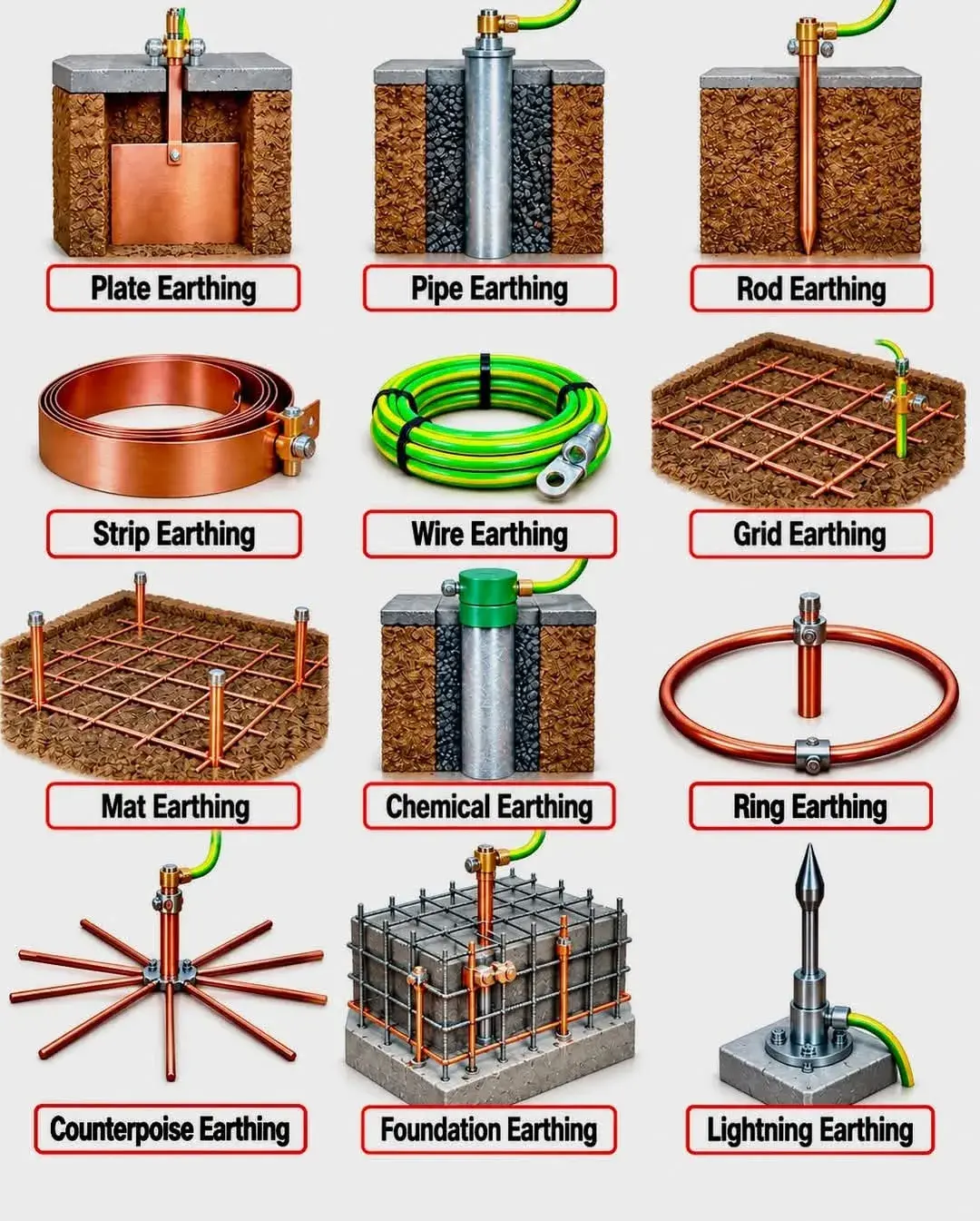
1. Plate earthing
A copper or galvanised iron (GI) plate is buried vertically in a pit, usually with its top edge at least 1.5 m below ground, and connected to the installation through an earth conductor. Traditionally the pit is packed with alternate layers of charcoal and salt to hold moisture; modern practice favours proper earth-enhancing backfill compounds, which corrode the electrode far less.
Where it's used: transformers, substations, generator sets, large motors and older commercial installations where a large contact area with the soil is needed to carry high fault currents.
2. Pipe earthing
A perforated GI pipe (commonly around 40 mm in diameter and 2.5–3 m long) is placed vertically in a borehole with a backfill of charcoal and salt or earthing compound around it. A funnel and chamber at the top let the pit be watered in dry months. It's cheap, easy to install and easy to inspect, which is why it's the most common earthing in Indian homes.
Where it's used: houses, shops, offices, residential societies and small commercial buildings with normal, moist soil.
3. Rod earthing
A copper or copper-bonded steel rod is driven straight into the soil — by hammering or with a small drilling rig — without digging a large pit. Several rods can be driven and joined together to bring the resistance down further.
Where it's used: sandy or soft soil, sites with very limited space, telecom and CCTV poles, street-light poles, and as the vertical electrodes in grid, mat and ring systems.
4. Strip earthing
Copper or GI strip is laid horizontally in a trench, typically at least 0.5 m deep. Because it runs along the ground rather than down into it, strip earthing works where you can't dig or drive deep — and the same strip is used to interconnect earth pits and equipment around a site.
Where it's used: rocky or hard soil where vertical electrodes can't go deep, along transmission and distribution lines, and as the ring main joining multiple earth pits in factories and solar plants.
5. Wire earthing
Wire earthing uses a stranded copper or GI conductor instead of a strip. Bare wire can be buried horizontally like strip earthing, and insulated green-yellow earth cable with crimped lugs is what connects every appliance, panel and socket back to the earth electrode (the "earth continuity conductor").
Where it's used: bonding equipment, DBs, inverters and appliance bodies to the earth bar, and as a horizontal electrode in rocky ground where strip isn't practical.
6. Grid earthing
A grid of horizontal conductors (copper or GI) is buried in a criss-cross mesh across the area and bonded at every crossing. The mesh keeps the whole surface at nearly the same potential during a fault, which limits dangerous step and touch voltages for people standing on it.
Where it's used: electrical substations, switchyards, power plants and large industrial plants that handle high fault currents.
7. Mat earthing
Mat earthing combines a horizontal grid with vertical rods driven at the crossings and around the edge. The grid controls surface voltages while the rods reach down to deeper, lower-resistivity soil — giving both the lowest resistance and the best step/touch voltage control.
Where it's used: HV substations and switchyards, generating stations, large factories and high-rise complexes with their own transformers.
8. Chemical (maintenance-free) earthing
A GI or copper-bonded electrode is placed in a borehole and surrounded by a conductive backfill compound (typically bentonite/graphite-based) that holds moisture and keeps resistance low and stable through the seasons — without regular watering or salt. It also corrodes the electrode far less than salt and charcoal, so it lasts much longer.
Where it's used: modern homes and apartments, rooftop and ground-mounted solar plants, data and server rooms, telecom towers, hospitals, and any site with dry or high-resistivity soil. It's what we recommend for most new installations.
9. Ring earthing
A bare conductor is buried in a closed loop around the outside of a building — usually at least 0.5 m deep and about 1 m out from the walls — and connected to earth rods and to the building's down conductors. Because it encircles the structure, it spreads fault and lightning current evenly on every side.
Where it's used: buildings with lightning protection, telecom shelters, control rooms, fuel and water tanks, and rooms full of sensitive electronic equipment.
10. Counterpoise earthing
Bare conductors are buried just below the surface, radiating outward from the base of a tower (or running parallel under an overhead line) and connected to the tower legs. The long buried length lowers the tower's footing resistance so lightning strikes on the line are drained without flashing over the insulators.
Where it's used: transmission and distribution line towers in rocky or high-resistivity soil, and radio/antenna masts.
11. Foundation earthing
An earth conductor is laid inside the concrete foundation of a new building and bonded to the steel reinforcement, then brought out at test points. Concrete below ground stays moist and is in contact with a huge area of soil, so a foundation earth gives low, very stable resistance for the life of the building at little extra cost — but it has to be planned before the foundation is poured.
Where it's used: new houses, apartment towers, commercial buildings, factories and warehouses under construction.
12. Lightning earthing
A lightning protection system has three parts: an air terminal (lightning arrester or rod) on the highest point, a down conductor running to the ground, and a dedicated earth pit to discharge the strike. The lightning earth pit is kept separate from the equipment earth pits, but the two systems are bonded together so no dangerous voltage can build up between them.
Where it's used: tall buildings and apartment towers, rooftop solar arrays, water tanks, factories, warehouses, schools, hospitals and telecom towers.
Which earthing is used where — quick reference
Most real installations combine two or more of these. A typical house uses pipe or chemical earthing with green-yellow earth wire to every point; a solar rooftop adds dedicated pits for the DC side, the AC side and the lightning arrester; a substation uses a mat with rods and strip interconnections.
| Type | Best for | Typical sites |
|---|---|---|
| Plate | High fault current, large contact area | Transformers, DG sets, substations |
| Pipe | Normal moist soil, low cost | Homes, shops, offices |
| Rod | Soft/sandy soil, limited space | Poles, telecom, small sites |
| Strip | Rocky ground, interconnecting pits | Factories, solar plants, lines |
| Wire | Bonding equipment to earth | Every panel, socket & appliance |
| Grid | Step/touch voltage control | Substations, power plants |
| Mat | Lowest resistance + surface safety | HV substations, large industry |
| Chemical | Dry soil, maintenance-free | Apartments, solar, data rooms |
| Ring | Even current spread around a building | Buildings with LPS, control rooms |
| Counterpoise | Lowering tower footing resistance | Transmission towers, masts |
| Foundation | Stable earth built into new structures | New buildings & factories |
| Lightning | Discharging lightning strikes | Tall buildings, rooftops, towers |
What earth resistance should you aim for?
Lower is better, and the target depends on what's being protected. Commonly used targets in Indian practice are around 1 Ω or less for substations and large power installations, under 5 Ω for homes and commercial buildings, and under 10 Ω for a lightning protection earth. Sensitive equipment such as servers, CNC machines and medical equipment often needs lower values, along with a low neutral-to-earth voltage.
Resistance changes with soil type and season — it is highest in dry months — so pits should be tested with an earth tester (fall-of-potential method) at installation and at least once a year, ideally in the dry season.
Signs your earthing needs attention
- Mild shocks from appliance bodies, taps or metal railings
- RCCB / ELCB tripping often, or never tripping when tested
- Inverter, UPS or solar inverter showing an "earth fault" or "ground fault" alarm
- Electronics failing more often than they should after storms
- An old pit that hasn't been tested in years, or corroded connections at the pit
Earthing installation in Zirakpur & the Tricity
Electrons installs, tests and upgrades earthing for homes, shops, apartments, solar plants and industry across Zirakpur, Panchkula, Chandigarh and Mohali — from single chemical earth pits to multi-pit systems with lightning arresters. We check your site, measure the existing earth resistance, recommend the right type for your soil and load, and hand over a test report after installation.
Frequently asked questions
Which type of earthing is best for a house?
For most homes, pipe earthing or chemical (maintenance-free) earthing is the right choice, with green-yellow earth wire run to every socket, DB and appliance. Chemical earthing costs a little more but keeps a low, stable resistance without watering, so we recommend it for new homes and for dry soil.
How many earth pits does a house need?
At least two independent earth pits is good practice so the installation stays protected if one pit or its connection fails. Homes with rooftop solar, a lightning arrester or a large inverter setup usually need additional dedicated pits.
What is the difference between chemical earthing and conventional earthing?
Conventional (plate or pipe) earthing relies on charcoal, salt and regular watering to keep the soil conductive, and its resistance rises in dry weather while the salt corrodes the electrode. Chemical earthing uses a conductive backfill compound that holds moisture on its own, so resistance stays low year-round with far less maintenance and a longer electrode life.
Does a solar system need separate earthing?
Yes. A rooftop solar system typically uses separate earth pits for the DC side (panel frames and structure), the AC side (inverter and output), and the lightning arrester, all bonded together. This protects the panels and inverter and keeps the inverter from raising earth-fault alarms.
How often should earthing be tested?
Earth resistance should be measured when the pit is installed and then at least once a year — ideally in the dry season when resistance is at its highest — and after any major fault or lightning strike.
Can the lightning arrester use the same earth pit as the house?
No. The lightning arrester should have its own dedicated earth pit, but that pit must be bonded to the main equipment earth so that no dangerous voltage difference can build up between the two during a strike.